Article
Securing the Connected Vehicle: Cryptography, Architecture, and Compliance for AIS-230
Article
Published 11 August 2026
The Future of Connected Mobility in India A Technical Deep-Dive into the AIS-230 Vehicle-to-Vehicle (V2V) Communication Standard
1. Executive Summary The automotive landscape in India is undergoing a massive shift towards connected mobility. The Ministry of Road Transport and Highways (MoRTH) has introduced a draft notification for the phased implementation of Vehicle-to-Vehicle (V2V) communication systems in motor vehicles, governed by the AIS-230 standard. By leveraging Cellular Vehicle-to-Everything (C-V2X) technology in the 5.9 GHz unlicensed spectrum, AIS-230 aims to significantly reduce road accidents through real-time, beyond-line-of-sight data exchange. As a trusted partner to OEMs and Tier-1 suppliers, AutoSec Innovation provides the specialized automotive cybersecurity and C-V2X engineering required to navigate this critical regulatory transition. This whitepaper breaks down the technical requirements, phased implementation timelines, and security implications of the AIS-230 standard for Category L, M, and N vehicles. 2. Introduction: The Need for V2V Communication Conventional vehicle safety systems, such as Advanced Driver Assistance Systems (ADAS), rely heavily on onboard sensors (cameras, radar, lidar) and driver reaction times. While effective, these systems are limited by direct line-of-sight and cannot "see" around corners, detect sudden braking multiple vehicles ahead, or warn of approaching emergency vehicles in dense traffic. V2V communication solves this by allowing nearby vehicles to continuously exchange real-time telemetry—including speed, position, direction, and acceleration. AIS-230 provides the standardized technical foundation to ensure all vehicles on Indian roads can communicate seamlessly, complementing existing ADAS systems and enabling proactive accident prevention.
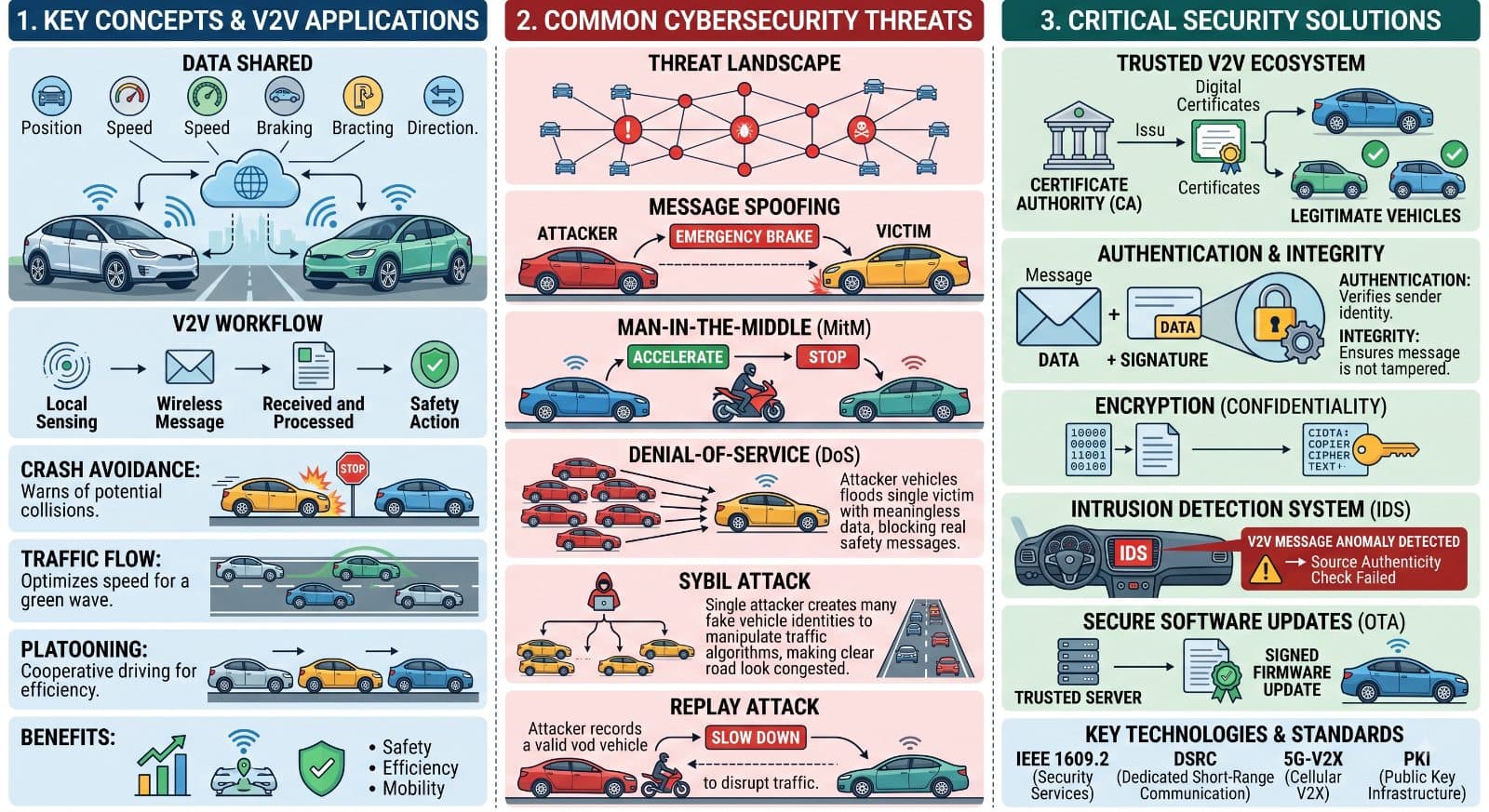
3. Core Technology: C-V2X and the 5.9 GHz Spectrum The AIS-230 standard is built upon robust, industry-proven technologies designed for low-latency, high-reliability communication: Technology Standard: The framework mandates factory-installed On-Board Units (OBUs) utilizing Cellular Vehicle-to-Everything (C-V2X) technology. Dedicated Frequency Band: V2V operations will take place in the 5.875 GHz to 5.925 GHz Intelligent Transportation System (ITS) frequency band. Licensing Exemption: To accelerate adoption, the Department of Telecommunications (under G.S.R. 466(E)) officially exempted the use of this specific 5.9 GHz frequency band from licensing requirements on June 10, 2026. 4. Principal Technical and Cybersecurity Requirements To ensure interoperability and safety across different vehicle manufacturers (OEMs), AIS-230 outlines strict minimum requirements for factory-installed systems. For OEMs and Tier-1 suppliers, compliance is not just about radio performance—it demands rigorous engineering across the following domains: Radio & RF Performance: Strict adherence to frequency stability, output-power requirements, and precise receiver sensitivity and selectivity. GNSS Integration: High-accuracy Global Navigation Satellite System (GNSS) positioning requirements to ensure exact vehicle location is transmitted. Cybersecurity & Communication-Security (AutoSec Innovation's Core Focus): V2V systems cannot function without a high-assurance trust model. AIS-230 mandates cybersecurity provisions to prevent signal spoofing, unauthorized message tampering, and malicious cyber-attacks. OEMs must align their OBU architectures with ISO/SAE 21434 and draft AIS-189 (CSMS/SUMS) frameworks, ensuring encrypted authentication protocols and robust Threat Analysis and Risk Assessments (TARA). Electrical & Environmental: Comprehensive electrical and power-supply regulations to withstand the harsh operating environments of motor vehicles. EMI / EMC: Electromagnetic interference and compatibility provisions to ensure the V2V unit does not disrupt other vehicle electronics.
5. Phased Introduction of Safety Use Cases The AIS-230 standard mandates specific performance requirements for road-safety applications, acting directly on the authenticated data received over the V2X stack. The primary use cases include:
1. Emergency Brake Alert (EEBL): Instantly notifies trailing vehicles if a leading vehicle applies hard braking, preventing multi-car pileups. 2. Forward Collision Warning (FCW): Alerts the driver of an impending rear-end collision with a vehicle ahead. 3. Wrong-way Driving Alert: Detects and warns drivers if they or an oncoming vehicle is traveling against the designated flow of traffic. 4.Emergency Vehicle Alert: Provides advance warning to drivers regarding the approach of emergency vehicles, allowing them to clear the path safely. 6. Implementation Timeline and Applicability The MoRTH draft notification proposes a phased regulatory timeline. The rules apply to Vehicle Categories L (two/three-wheelers), M (passenger vehicles), and N (goods vehicles), meaning the entire Indian automotive spectrum—from scooters and auto-rickshaws to commercial trucks and passenger cars—must comply:
Phase 1 (October 1, 2027) - Voluntary Fitment Compliance: Any vehicle manufactured on or after this date that is voluntarily fitted with a V2V communication system must comply fully with the AIS-230 standard. Phase 2 (October 1, 2028) - Mandatory Fitment: All newly manufactured vehicles in categories L, M, and N must be factory-fitted with V2V communication systems conforming to AIS-230 specifications.
7. How AutoSec Innovation Supports OEMs and Tier-1 Suppliers The mandate for V2V communication shifts the automotive industry from isolated onboard systems to a connected, vulnerable ecosystem. The technical burden of ensuring message authenticity, conducting V2X interface threat analysis, and executing rigorous penetration testing is massive.
AutoSec Innovation provides end-to-end AIS-230 and V2V cybersecurity services to automotive manufacturers and Tier-1 suppliers. Our capabilities include: OBU Item Definition & Boundary Analysis: Defining the V2X context and trust boundaries early in the engineering cycle. TARA for V2X Interfaces: Extending Threat Analysis and Risk Assessment to cover communication-security threats and safety-relevant message misuse for Indian operating conditions. Architecture & Requirements: Translating AIS-230 cybersecurity provisions into actionable requirements for C-V2X stacks. Verification & Penetration Testing: Planning and executing testing that covers security controls, radio performance, and application behavior to prove the V2V security chain. 8. Conclusion The implementation of the AIS-230 standard represents a critical milestone in India's Intelligent Transportation Systems (ITS) roadmap. By mandating C-V2X technology and providing dedicated unlicensed spectrum, the government is laying the groundwork for a highly connected mobility ecosystem. OEMs, 2- and 3-wheeler manufacturers, and Tier-1 suppliers must act now to integrate these technical and cybersecurity mandates into their 2027 and 2028 vehicle programs. Partnering with specialized engineering firms like AutoSec Innovation ensures that compliance is achieved securely, reliably, and on time.
For more information on integrating AIS-230 compliant solutions and securing your connected vehicle architecture, contact AutoSec Innovation at info@autosecInnovation.com or visit https://www.autosecinnovation.com/